In this article
A message saying your car is ready tells you when to collect it, but not exactly what was achieved. Allow a short conversation with the service adviser rather than treating handover as a payment and key exchange. This guide organizes the questions, paperwork and observations. It does not replace a technician’s inspection or establish remotely that a vehicle is safe to drive.
Before collection: prepare your comparison
Bring the repair request or estimate you approved, together with any later approvals for extra work. Keep the original symptom description available: when it happened, under what conditions and whether it was constant or intermittent. Compare the outcome against that description rather than a vague statement that the car was serviced. Ask whether all work is finished or a part is still awaited, who will explain the report, and whether collection time allows a discussion before closing.
Use three clear columns
Create a small list of agreed work, completed work and items postponed or needing follow-up. If you requested investigation of a noise and an oil change, separate those outcomes: finishing one does not demonstrate completion of the other. This is a suggested organizational method, not a mandatory workshop form. It makes unresolved questions easier to see without requiring technical expertise.
Ask for an understandable explanation
Start with: “What cause did you identify, and what changed to address it?” Distinguish a finding supported by testing from a possibility that needs monitoring and from routine servicing unrelated to the complaint. A replacement part’s name alone does not explain its connection to the symptom. Nor does a warning disappearing at collection, by itself, prove that an intermittent problem has been resolved.
When the symptom did not occur at the workshop
Record that outcome honestly rather than relabelling it as repaired. Agree what information would help if it returns: date, mileage, operating conditions and a description of the event. Do not handle your phone while driving to capture evidence. Ask whether there are temporary instructions or further checks, and identify the contact for a recurrence. A clear next step is more useful than leaving with an assumption.
Compare the final invoice with your approval
The FTC recommends obtaining a completed work record showing repairs, supplied parts, costs, labour and odometer readings. Use that as an organizational checklist, not as a statement of Saudi law. Read item names and quantities, separate parts from labour and listed charges, and ask for an explanation of differences between the estimate and final invoice.
If an unfamiliar item appears, ask when it was added and which approval relates to it. The explanation may be straightforward, such as several operations grouped under one short label. The aim is clarity rather than an assumption of misconduct. Keep a readable document identifying the car, visit and provider. A payment notification alone does not explain the work performed.
Observe the car without doing the technician’s job
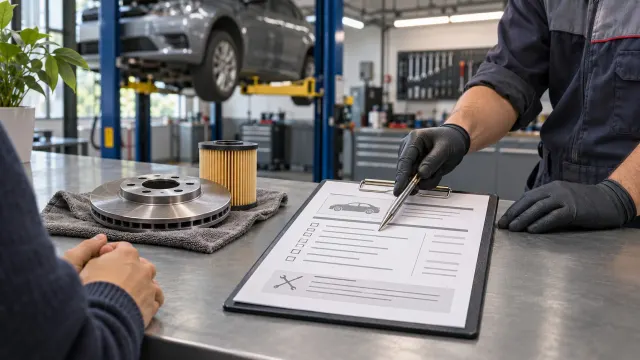
Review it in the designated collection area with the adviser. Compare visible condition with the notes or photographs recorded at drop-off, and check the keys and belongings. Ask the technician to explain the work at an appropriate location when that can be done safely. Do not enter an active work area, stand beneath a raised vehicle or open a hot system to inspect it yourself.
A handover drive is not a stress test
If a suitable handover drive is offered, agree who will conduct it and how the result will be recorded. Do not attempt sudden braking or recreate a dangerous condition to prove the repair. If a warning or concerning change in braking or steering remains, pause the practical handover and obtain professional assessment and the vehicle’s instructions before driving. A short successful trip cannot guarantee that every intermittent issue is gone.
Make warranty and follow-up details specific
Ask what this repair’s warranty covers, any time or mileage limit, where to make a claim and which records are needed. Do not assume a part warranty includes replacement labour or that another provider’s policy applies. The FTC highlights written terms; the AA site provides an example of a policy specific to its UK network. Its duration is not a promise for Saudi workshops.
Separate future recommendations from completed work. For a later check, record the reason and the date or condition that should trigger a return, rather than “come back soon.” If an item remains unfinished, ask for its current status and the plan to complete it instead of leaving it in the completed-work list.
Five answers before you leave
- What was actually completed, and what was not?
- Was the original concern resolved through a clear check, or does it need monitoring?
- Do I understand the invoice and any difference from the approved estimate?
- Do I have written warranty and contact details?
- Are there instructions or concerns that mean I should not drive away yet?
A useful handover does not turn you into a mechanic. It gives you an understandable account of the car’s condition, a clear work record and an agreed next step where questions remain. Sources reviewed by 2uto on 15 November 2026. This is a general practical framework, not local legal advice or an endorsement of any particular workshop.
Sources & references
Explore the details and read the information at its source.